.svg)
Sergio Mannino Studio
Architectural Branding
Architectural Branding
.avif)
Medly Pharmacy is a new neighborhood pharmacy in Brooklyn, owned by Marg and Sahaj Patel and designed by Sergio Mannino Studio.
In a city of more than 8.5 million people, it’s no surprise that the simple act of visiting a pharmacy is often an impersonal experience. Because there’s one of every corner, it is incredibly convenient - but chances are, you won’t know who’s serving you. In a society of such high import and export, you’re also spoilt for choice when it comes to which brand, which flavor and even which size of product to buy.
Independent pharmacies answer that problem differently. The design has to do what the chain model never attempts: communicate trust, warmth, and community before a word is spoken. That is the core challenge of pharmacy design, and it is where Sergio Mannino Studio has built specific expertise across multiple locations.
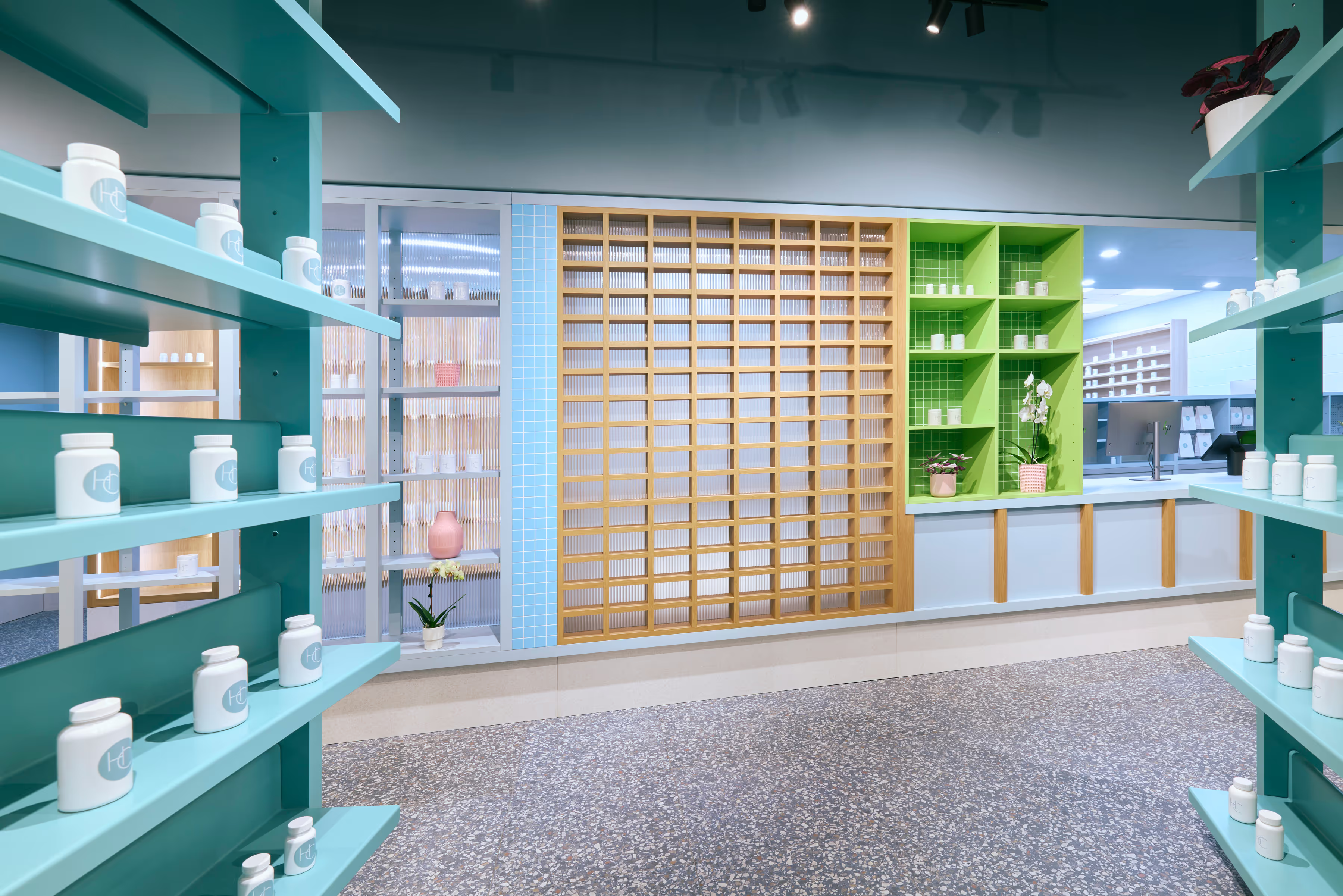
Medly Pharmacy aims to remedy this through a slightly different approach. Being the first location in a series of pharmacies, we knew that the space needed to look beautiful. The design is both playful and elegant; a buffed cement counter with clean geometric tiles as part of a light aqua colour scheme. The pharmacy consists of two rooms; a cozy waiting room where customers collect prescriptions, and a much larger space out the back, where the administration and prescription work is done. The waiting room is comfortably-sized and provides an escape from the busy city streets outside.
As community is a key value of Medly pharmacy, we ensured our design was tailored to include this. The nature of the small space means that customers will instinctively connect with each other and with the staff, unlike larger pharmacies that inadvertently separate people through high aisles and sheer size.
Medly also have an easy to use, complementary app that customers can use to have prescriptions delivered directly to their door. Owning ten pharmacies already, Marg and Sahaj have ample experience with what makes these often clinical places warmer, more comfortable and more community-focused for customers and staff alike. We’re happy to have been able to design this space to suit the values that we believe in too.
Sergio Mannino Studio is a New York-based architectural branding firm specializing in pharmacy retail design across the country.
Store Address: 104 Graham Ave, Brooklyn NY
Area: 1,900 sqft
Opening date April 2018
Lighting Design: Bill Pierro Jr., Lido Lighting
Photography: Charlie Schuck
.avif)
.avif)
.avif)
.avif)
.avif)
.avif)
.avif)
.avif)
.avif)
.avif)
.avif)
.avif)
.avif)
.avif)

If you want to survive and if you have a large chain, yes. But the physical space still matters. Medly was designed as both a neighborhood pharmacy and a digital fulfillment center. Customers can order online for same-day delivery, or walk in to experience a beautifully designed space. The front is a cozy waiting room with a custom concrete counter, Bisazza tiles, and modern seating specifically designed for the brand. The back is an efficient workspace for fulfillment. A door separates them, so the front feels calm while the back stays operational. This is the future: physical retail spaces that work as neighborhood anchors and fulfillment centers. The design has to support both without compromising either.
Small isn’t the problem. Generic is the problem. Medly is intimate by design—around 1,900 square feet with most of the space used as a production and fulfillment center. In a well-designed small space, customers connect with staff and each other. There’s no wall of shelving separating them. No, industrial-scale making everyone feel anonymous. The pharmacy becomes a neighborhood place again, not just a pickup point. People know the pharmacist’s name. The pharmacist knows theirs. It’s all about human relationships; intimacy is a design decision.
Something durable, beautiful, and completely different from hospital tile. Medly uses patterned cement tiles by Jamie Hayon, colorful, geometric, and sophisticated. They’re durable enough for high traffic but elegant enough to signal care and craft. Most pharmacies use cheap vinyl or industrial tile because “it’s practical.” But practical doesn’t have to mean ugly. Good flooring grounds the space. It’s the first thing people see when they walk in. Make it count.
Materials that are durable, beautiful, and don’t look like a hospital. Medly uses cast concrete (honest, tactile, permanent), Bisazza cement tiles (colorful but refined), custom metal mesh (elegant and functional), and vinyl seating inspired by Shiro Kuramata (sophisticated, easy to clean). The key is choosing materials that age well and signal craft. Cheap laminate counters scream “budget.” A custom concrete counter with a color gradient says someone cared about every detail. Scarpa did this obsessively—using materials with precision and purpose. A counter isn’t just a surface. It’s a statement about what the pharmacy values.
Function first, but make it beautiful. The counter is where transactions happen, where trust is built, where customers interact with staff. It needs to work operationally: right height, enough space for computers/printers, secure storage for prescriptions. But it’s also the visual anchor of the space. Medly’s counter is cast concrete with a gradient from green to white. It’s sculptural, unique, memorable. It’s a statement beyond functionality. Compare this to the generic laminate counters in most pharmacies. They work, barely. But they communicate nothing except “we didn’t think about this.”
If you want your pharmacy to be memorable, custom. It’s usually a bit more expensive but you get a unique store. Standard pharmacy furniture looks standard. Everyone has the same shelving, the same seating, the same fixtures. Your pharmacy blends in. Custom furniture solves specific problems for your specific space. At Medly, we designed a custom pendant light, a gradient concrete counter, and modern chrome seating. These elements define the entire experience. We see furniture and architecture as part of the same thought process, not two separate elements. In the best Italian Design tradition, architects, interior designers, and furniture designers were always the same person. Design it like you mean it and everything will feel like it belongs. That’s what custom work achieves.
Design for humans, not for inventory management. Medly feels welcoming because: • The color palette is aqua and clean white—fresh and unique, not sterile; • The space is small and intimate; • The materials are warm and tactile: concrete, tile, steel; • The seating invites you to stay; • Custom details (pendant light, metal mesh, gradient counter) show care for details; When you showcase an environment that is built with great care, you project the same value to your customers. If you care about the environment where you greet your clients, then you must care for them as well. This is subliminal design messaging.
Loyalty. Press. Differentiation. Efficiency. A well-designed pharmacy: • Becomes more memorable (customers return because the experience is better) • Attracts press and attention (Medly was featured widely; good design gets covered) • Functions more efficiently (better layouts = faster service) • Signals higher value (people trust pharmacies that look professional) The ROI is reputational, operational, and emotional. All these then translate into profit, but you cannot build it focusing on profit and then hope to get loyalty later. It doesn’t work. A beautifully designed pharmacy becomes a neighborhood landmark. A generic one becomes forgettable. Good design attracts customers who care about quality, not just price. Those are the customers worth designing for.
Critical. And completely ignored by most designers. The back area, where prescriptions are filled, inventory is stored, and where your staff work, needs as much design intelligence as the front. If it’s disorganized, inefficient, or depressing, your staff suffers and service slows down. At Medly, the back-of-house is designed like a clock, very efficiently: clear zones for different tasks, good lighting, organized storage, and a sequence that follows the exact workflow of their business. It’s not beautiful for customers, it’s beautiful for staff. You cannot focus solely on your customers and ignore your employees. If you do that, they will eventually leave for a better environment.
Yes. That’s literally your only advantage. Chain pharmacies compete on convenience and price. You can’t win there. But you can win on experience, design, relationships, and community. A small, beautifully designed pharmacy where the pharmacist knows your name and the space makes you feel good, that’s worth more than saving two dollars on ibuprofen. Medly proved this: small footprint, strong design, digital integration, personal service. Customers choose it over chains because the experience is better. That’s the model.