
.svg)
.avif)

After designing retail stores and brand identities for over 15 years, we can tell you the single most common problem we see: the brand says one thing, and the store says another.
The logo was designed by one team, the interior by another, the website by a third. Each delivered good work. None of it feels like the same brand. A customer walks in, senses the gap at a gut level, and walks out without knowing why.
We have watched this happen with pharmacies, fashion boutiques, cannabis dispensaries, and even butcher shops. The brand deck says "warm and community-driven." The store looks like it was ordered from a catalog. Nobody made a bad decision. The process itself was the problem, because no one was responsible for the whole picture.
A cohesive retail brand strategy fixes this, and it requires a way of working that most brands have never tried.
Why most retail brands feel disconnected
The typical process goes like this. A brand hires an agency to create a visual identity. Then they hire an architect to build the store. Then a web team handles everything digital. Three talented teams, three separate conversations, zero shared framework.
The branding agency delivers a beautiful logo and guidelines. The architect designs a beautiful space. But the logo communicates "handcrafted warmth," while the interior communicates "clean and minimal." The packaging promises intimacy. The store feels like a hospital waiting room.
We once walked into a new café in Manhattan where the brand's Instagram was all hand-lettered type and earthy tones, reclaimed wood in every photo. The actual space had white laminate shelving and fluorescent lighting. The owner had hired a talented graphic designer and a competent contractor separately, and nobody had asked whether the two outcomes would feel like they belonged to the same business. They didn't.
Customers process contradictions like these instantly. Not through analysis, but through feeling. The space doesn't match the promise, and trust erodes before the first product is touched. We have seen this pattern explain why stores underperform when everything else, the product, the pricing, the location, seems like it should work.
The fix is not better coordination between separate teams. The fix is building brand and space as one thing from the start.
What a cohesive retail brand actually looks like
A cohesive retail brand is not one where the same hex codes appear on the wall and the website. That is visual consistency, and it is the bare minimum. You can match your Pantone swatches perfectly and still have a store that feels completely disconnected from your brand.
Real cohesion means that when a customer moves from your Instagram feed to your front door, nothing jars. The spatial experience delivers the same emotional promise that the digital experience made. The staff's behavior matches the brand's tone. The materials on the counter echo the values in your mission statement.
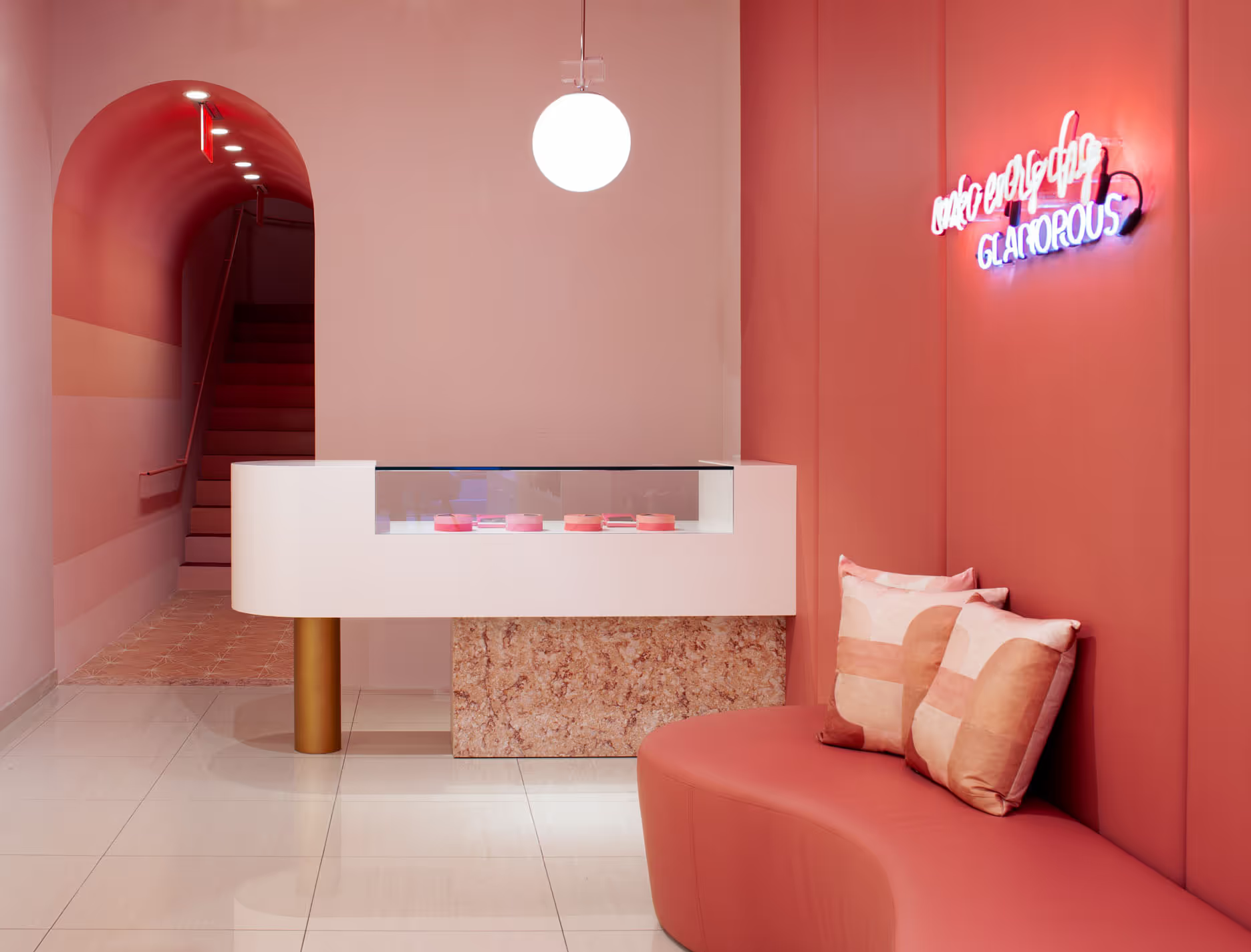
When we designed Medly Pharmacy in Brooklyn, the brand was built around neighborhood intimacy and personal care. So the interior had to feel like a neighbor's living room, not a CVS. We used patterned cement tiles by Jamie Hayon, a custom concrete counter, and seating designed specifically for the brand. The space is about 1,900 square feet, and that smallness is intentional. People know the pharmacist's name. The pharmacist knows theirs. Every material decision, every spatial proportion, every piece of furniture reinforced the same idea: this place sees you as a person, not a prescription number.
That is what cohesion actually feels like. A style guide can give you matching colors. Architectural branding gives you a space where the brand and the building are the same thing.
How to build a retail brand identity that translates into physical space
1. Define the emotional premise before any design begins
Before sketching a logo or choosing a material, define what the customer should feel at each stage of their journey with your brand. Not what they should see. What they should feel.
Think of it the way a film director works. Nobody starts a movie by picking the color of the curtains. You start with the story, the emotional arc, the feeling each scene should produce. Then the cinematographer, the set designer, and the costume department all serve that arc. Retail works the same way. If the premise is "calm confidence," then the typography, the ceiling height, the lighting temperature, and the way the staff greets someone who walks in all need to serve that feeling.
Most brands skip this step. They start with a logo. Then they try to translate that logo into a three-dimensional experience and wonder why it feels forced. Starting with the emotion prevents this. We do it on every project because without it, you end up decorating a space instead of designing a brand.
2. Develop branding and store design as one integrated process
When a branding team and an architecture team work from the same strategic brief at the same time, the brand becomes spatial naturally.
Colors get chosen for walls and screens simultaneously. Typography gets tested at signage scale, not just on business cards. Materials become part of the brand vocabulary rather than afterthoughts selected by a contractor three weeks before opening day.
When we worked with Wholesome Cuts, the butcher shop in Williamsburg, we didn't design the interior and then hand it off to someone else to "brand." The walnut counter, the white quartz, the porcelain floor that recalls Carrara marble from traditional Italian butchers, the hand-painted cow mural by artist Iena Cruz: all of it was developed alongside the brand story of ethically sourced, locally farmed, traceable meat. The design process took three weeks. It worked because the brand and the space were never two separate projects.
At our studio, we design brand identity and the physical environment together because we have seen, project after project, that this is the only reliable way to produce a retail space that feels like it was inevitable rather than assembled from parts.
3. Treat materials as brand language
A hand-finished plaster wall tells a different story than painted drywall. Brass hardware says something different from matte black steel. Cement tile communicates something walnut flooring does not. These are not aesthetic preferences. They are strategic decisions, as deliberate as choosing a typeface or writing a tagline.
Consider the difference between walking into a space with raw, natural surfaces and walking into one with polished laminate. Before you've consciously registered anything, your body has already made a judgment about the kind of business this is, what it values, how it treats its customers, and roughly how much things cost. Materials do that work silently, and most brands don't give them nearly enough attention.
We build a focused material palette for each client, testing how every finish communicates at a sensory level. Repetition across locations builds recognition. Variation within a palette keeps things alive. The goal is a store where the surfaces do half the brand's communication before a customer even reads the signage.
4. Design the customer journey as spatial storytelling
A well-designed store doesn't deliver every message at the entrance. It unfolds.
We think of every retail project in chapters: arrival, orientation, discovery, consideration, and resolution. The first ten seconds are about establishing tone. Walk into a store, and your eyes adjust, you take in the size and the light, and you decide whether this place is for you. Retail designers call this the decompression zone, and it is the most wasted piece of real estate in most stores, because owners cram it full of product that nobody is ready to look at yet.
The middle of the journey is about rewarding curiosity. Drawing people deeper. Creating the feeling of choice without overwhelming the mind. And the ending should leave a clear impression, something the customer carries out the door and, ideally, talks about later.
When this sequence is designed deliberately, customers move through the store without needing signs or arrows. The layout is doing the work. That is the difference between a floor plan (geometry) and a real retail layout (choreography).
5. Extend the brand system across every touchpoint
Once the spatial and visual language is defined, apply it everywhere with discipline. Packaging, shopping bags, the website, email, social media: every touchpoint should feel like it belongs to the same family.
This doesn't mean making everything identical. A shopping bag and a storefront are different formats with different constraints. What it means is establishing clear rules about color, typography, material, and tone, then applying those rules with intelligence. The strongest brand guidelines are the ones built alongside the spatial design, because they account for how the brand lives in three dimensions. Guidelines written after the store is already built almost always feel like an afterthought, because they are one.
Where retail branding strategies break down
After years of working in this space, we see the same patterns over and over.
Separation
Brand strategy is developed by one firm, store design executed by another. The brand deck talks about craftsmanship and heritage. The store has the same fixtures as every other retailer in the mall. We have inherited projects like this, and the cost of fixing the disconnect after the fact is always higher than doing it right from the beginning.
Trend chasing
The brand adopts whatever aesthetic is popular this season instead of building an identity rooted in its own values. We saw this with the all-white minimalist wave a few years back, where every new store in New York looked like the same Instagram backdrop. Trends expire. An identity built on strategy does not.
Overloaded interiors
The store is packed with so many products that the brand has no room to breathe. Density kills the perception of quality and curation. A well-curated small store feels more premium than a massive one stuffed wall to wall with inventory. We learned this early on with our pharmacy and fashion retail projects, and it holds across every category we have worked in.
Treating the store as a backdrop
The physical space is seen as a container for products, as a necessary expense rather than what it actually is: the most powerful brand communication channel a retailer owns. More persuasive than advertising. More memorable than social media. The physical experience is where brand promises are either proven or broken.
The brands that avoid these mistakes all share one trait: they treat the store as a primary brand asset.
We approach every project, from pharmacy interiors to fashion flagships to café concepts, with the same integrated methodology. We design the brand and the space as one thing because, in the customer's mind, they already are.
FAQs
What is retail branding?
Retail branding is the process of creating a unified identity for a retail business across every customer touchpoint. Visual identity, messaging, how the staff behaves, the physical store: all of it. When done well, a customer can walk into your store and understand what your brand stands for before looking at a single product. When done poorly, the store contradicts the website, and the customer trusts neither.
What is the difference between retail branding and product branding?
Product branding builds loyalty to a specific item through features, packaging, and positioning. Retail branding is broader. It shapes the identity of the entire business, including how it feels to shop there, how the staff interacts, and what the store communicates as a space. A customer might love a product, but retail branding determines whether they love the store itself and choose to come back.
How does store design affect brand perception?
Massively. Customers form judgments within seconds of entering, based on spatial cues: lighting, materials, proportions, how crowded it feels, and whether the layout makes sense. A store that feels considered signals quality. A store that feels generic signals the opposite, no matter how strong the brand's online presence is. Research by Paco Underhill and others has shown that these first impressions are largely unconscious, which means they are very difficult to override with signage or marketing once they have been formed.
Can a small brand afford an integrated branding and design strategy?
Yes, and a small brand arguably needs it more than a large one. Bigger brands compensate for inconsistency with massive advertising budgets. A smaller brand doesn't have that luxury. If the store contradicts the website, there is no national campaign to smooth it over. The integrated approach doesn't require a bigger budget. It requires working with a team that thinks across both disciplines from the beginning, so the money you do spend goes further and produces something coherent.
Sergio Mannino Studio is a design agency in New York that has spent over 15 years designing retail stores and brand identities as one integrated discipline. Our clients include fashion brands, pharmacies, cafés, jewelry showrooms, and cannabis retailers. See our work.
If your brand is ready for a store that feels as considered as your identity, let's talk.
11a%20.avif)
