.svg)


How to Choose a Retail Design Firm: What You’re Actually Buying When You Hire One
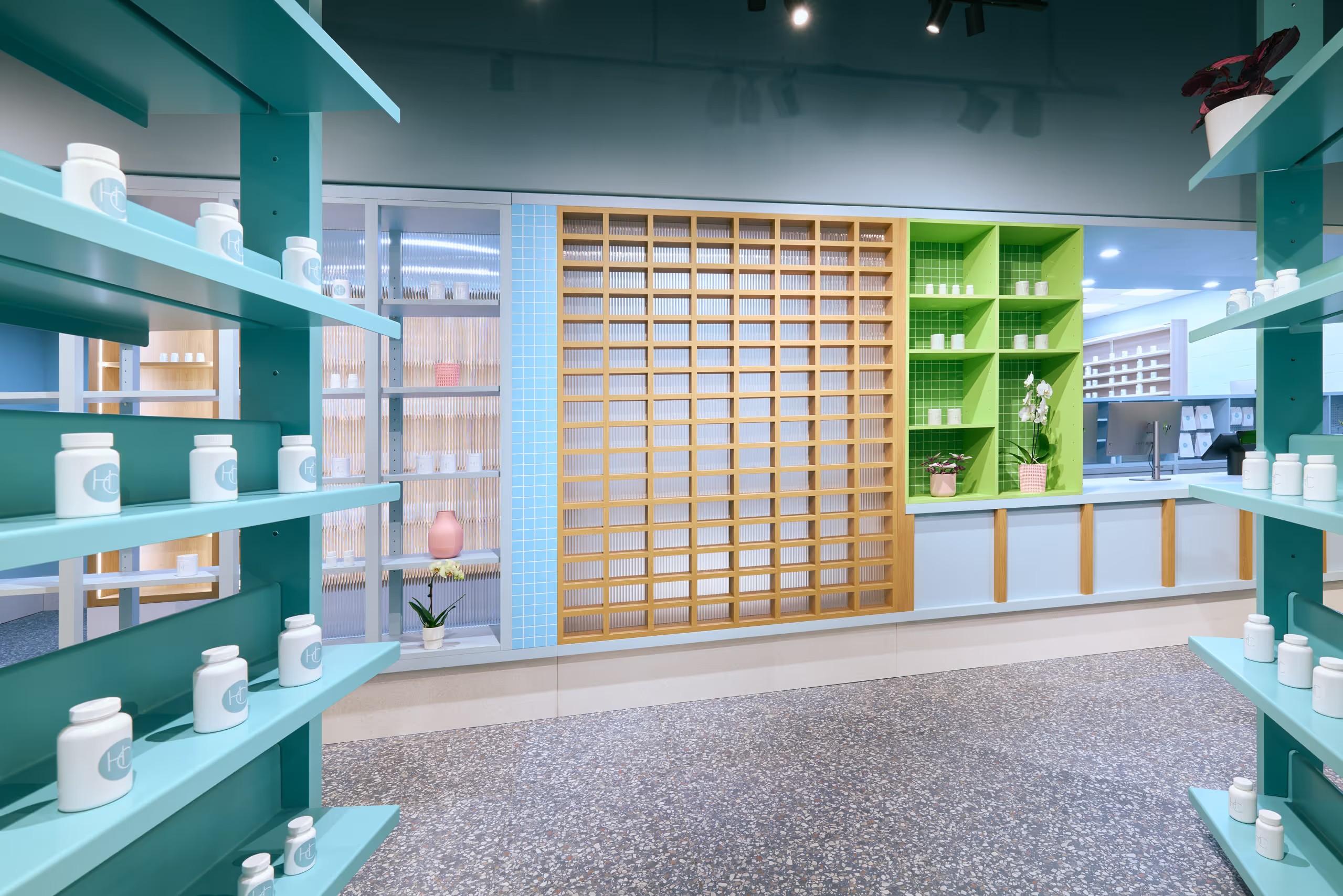
The first pharmacy I ever designed started with me telling the client I’d never done one. A group from Egypt came to the studio and explained what they wanted. I was honest, I said I have never designed a pharmacy. I don’t know how one works, how the back of house connects to the counter, what the regulations are, how the pharmacist moves through the day. The client wasn’t worried. He said don’t worry about it, we’ll sit down around the table, and in three hours you’ll know everything. That’s what we did and all it took was three hours. Then we designed it and the pharmacy was widely published and became the most successful in the neighborhood.
The specialization trap
A firm that has designed forty shoe stores has forty reasons to design the forty-first the same way. Specialization, past a certain point, becomes repetition. You stop solving the problem in front of you and start reaching for the solution that worked last time. The client thinks they’re buying certainty. What they often get is a template, applied to their brand whether it fits or not.
Some of our strongest work came from commissions we had never done before. The pharmacy is the clearest case. Coming in with no fixed idea of what a pharmacy should be, we had to look at the problem directly, with none of the residue of past projects deciding it for us.
Architects and designers are trained on a wide range of project types, but mostly they are trained on process. Moving from a store to a restaurant to a pharmacy is not the leap clients imagine it to be. The fundamentals carry. What doesn’t carry, what actually defines a studio, is something else entirely.
What you should look for instead
Each studio has a language. A way of handling materials, colors, proportion, lighting, what to emphasize and what to leave quiet. That language is consistent across everything they do, whatever the category. It’s the thing that makes their work recognizably theirs. Creatives spend their entire lives perfecting that language because it fits their interests, obsessions, curiosities, and their vision of the world in cultural and political terms. They are not changing that.
That language is what you’re actually hiring. And the only question that matters is whether it aligns with what your brand needs to say.
A client I did not want to work with for this same reason once told me that musicians can play blues in the morning and classical music in the evening. And that may be true, but the musicians with a defined voice tend not to move across genres that way: Pollini doesn’t play rock, and Nick Cave doesn’t play Disco.
The studio will deliver something competent and well-made, and it will feel wrong, because the studio’s natural vocabulary pulls in a direction the brand doesn’t want to go. No amount of category experience fixes that. So the question is not if have you done this before. The question is do you see the world the way this space needs to feel.
How to read a portfolio
This changes how you should look at a portfolio, and it asks more of you than the usual scan.
Don’t audit it for categories. Don’t look for the specific display in the specific department store, or the shoe store for the specific demographic. Those questions don’t help. A studio could have built exactly that project and still be wrong for your brand. A yes tells you nothing.
Look instead at the sensibility behind their work. How do they make decisions, what they emphasize, what they leave out. How do they use colors and materials, what type of atmosphere recurs across projects that have nothing else in common. Read it the way you’d read a body of work by a writer or a filmmaker, for the point of view, not the subject matter. Then ask whether that point of view belongs in the same conversation as your brand.
That’s a much harder way to look, even if it’s the most instinctive. It’s also the only one that predicts the result.
Why this matters more now
There’s a reason this keeps getting more true.
Specialization was valuable when expertise was scarce and hard to move from one head to another. That’s no longer the situation. The technical answer to almost any specific question is now available instantly to anyone. AI can give you information on code requirements, standard dimensions, or almost anything specific you need. The specialized fact has become a commodity.
What hasn’t become a commodity is judgment. The ability to look across a wide range of fields, draw connections nobody asked for, and arrive at a point of view that holds together. That’s a generalist’s skill, and it’s exactly what a designer with a broad body of work has spent years building. The skills that matter going forward are the ones that synthesize. For retrieval, you have a machine.
So when you hire a studio, the category knowledge is the cheap part. You can get it in an afternoon around a table, the way my pharmacy client and I did. What you’re paying for is their judgment, their language, and whether those two are right for what you’re trying to build.
Your half of it
Choosing the right studio is only half of what makes a project good. The other half is you.
My pharmacy clients could have walked out when I told them I’d never done one. Instead they sat down for three hours and taught me what I needed to know. That willingness, to trust the studio’s language enough to invest in the brief, is what let the project become what it became. The best work needs a client who’s willing to be the client that work requires.
So when you evaluate a studio, evaluate yourself too. Are you choosing by category because it feels safe, or are you willing to look harder, at language, at sensibility, at whether this is a studio that sees what you see. The answer shapes the result as much as anything in their portfolio.
If you want to see how we think about retail specifically, our retail design work is built on this premise. The same logic runs through how we approach architectural branding and the way we worked on that first Careland pharmacy. And if you want to see this against real names working in New York right now, here's how we compare retail design companies.
Frequently asked questions
How much does a retail design agency in NYC charge?
It depends on scope, square footage, and whether branding is included. A project that covers brand identity and store design from concept through construction documentation will typically land in the mid-five to six-figure range for a single location. There is no useful "average" because a 500-square-foot pharmacy and a 5,000-square-foot fashion flagship are entirely different projects.
The most expensive outcome, consistently, is hiring cheaply, ending up with a store that does not work, and redesigning within two years.
What is the difference between retail design and interior design?
Interior design focuses on making a space aesthetically functional. Retail design includes that, but adds customer psychology, merchandising strategy, operational flow, and brand storytelling. The output is a space that drives brand perception and commercial performance, not just a good-looking room. A residential interior designer and a retail designer look at the same empty room and see completely different problems.
How long does a retail store design project take?
Most projects run four to eight months from strategy through construction documentation. The research and brand development phases at the front end are where the real decisions get made, and rushing them almost always results in expensive corrections later. We have seen clients lose months of rent because they signed a lease before they had a design team in place. As we wrote in a previous article, you do not need a location to start designing. You can develop your entire brand and store concept on a dummy floor plan, take as much time as you need, and adapt it to the real space once you sign the lease.
Sergio Mannino Studio has spent over 15 years designing retail stores and brand identities as one integrated discipline from our Brooklyn studio. Our clients include fashion brands, pharmacies, cafés, jewelry showrooms, and cannabis retailers.
Ready to build a store that works as well as it looks? Let's talk.