.svg)

I asked Chat GPT to "Design a Coffee Shop" and I immediately got 3 suggested prompts to choose from:
Design a coffee shop... layout that encourages conversation;
Design a coffee shop... with a cozy ambiance;
Design a coffee shop... that promotes community
I went for the 2nd one without adding anything else, no neighborhood, no client, no budget, no idea, and got this:
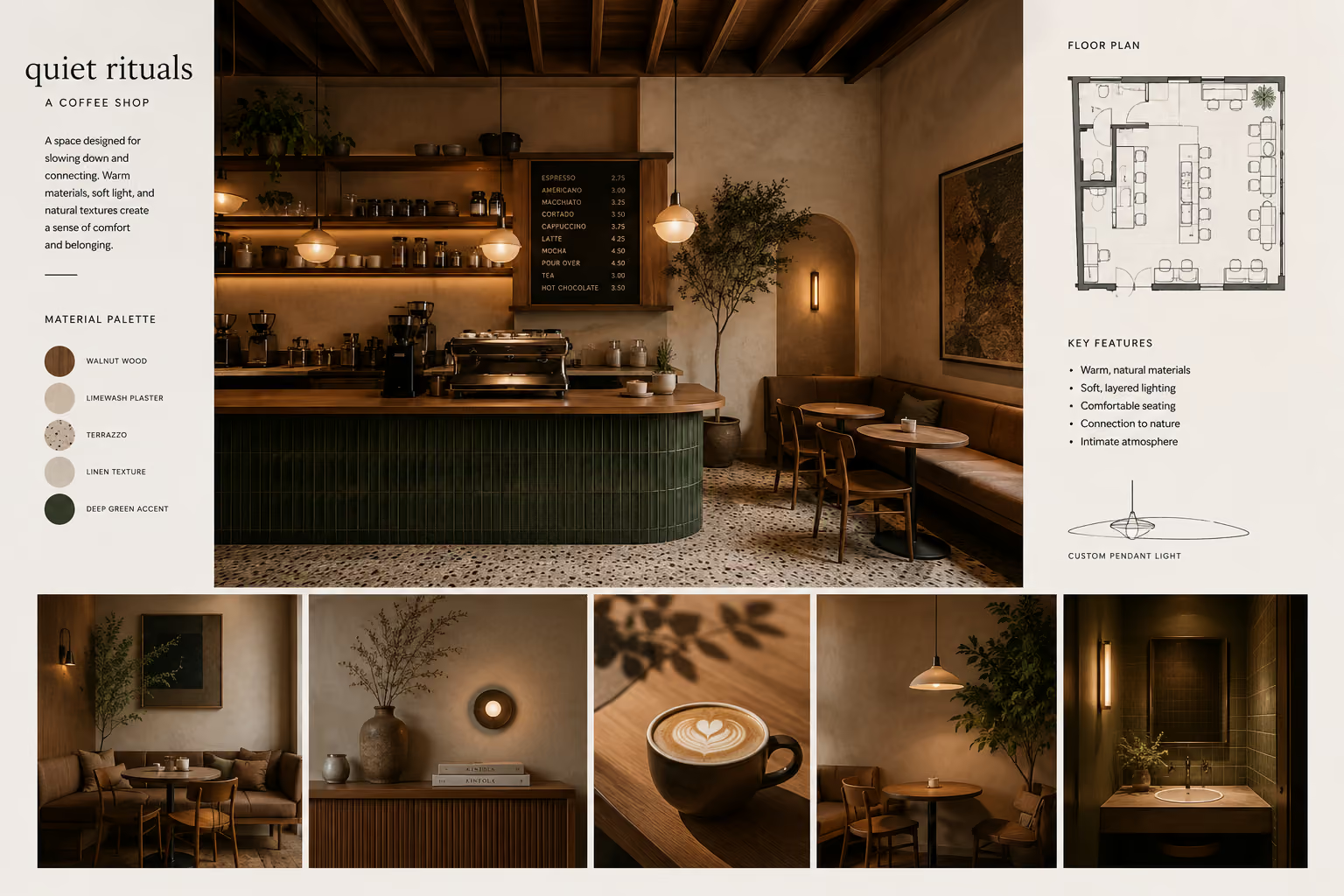
The answer arrived in seconds: earthy terrazzo floor, beige walls, brown fixtures, a counter in green tiles, a semicircular arch, a few plants here and there, wood beams on the ceiling and an overall soft light that photographs well. The machine is not guessing, it is answering the question the way a statistician answers a question, by returning the most probable room. And the most probable room turns out to be a room everyone has already been in (never mind that the floor plan doesn't match the photos, or that the toilet sits next to a customer table).
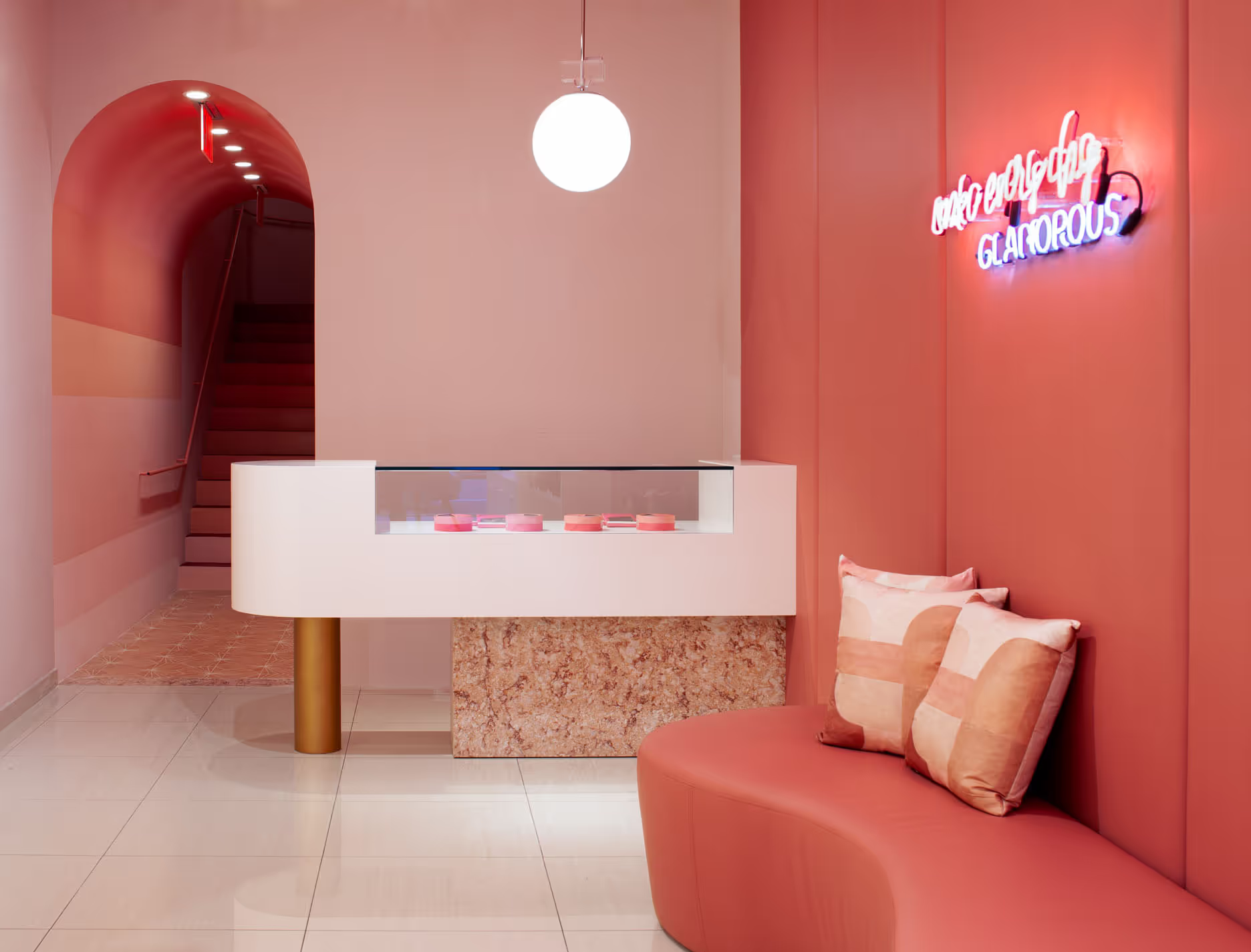
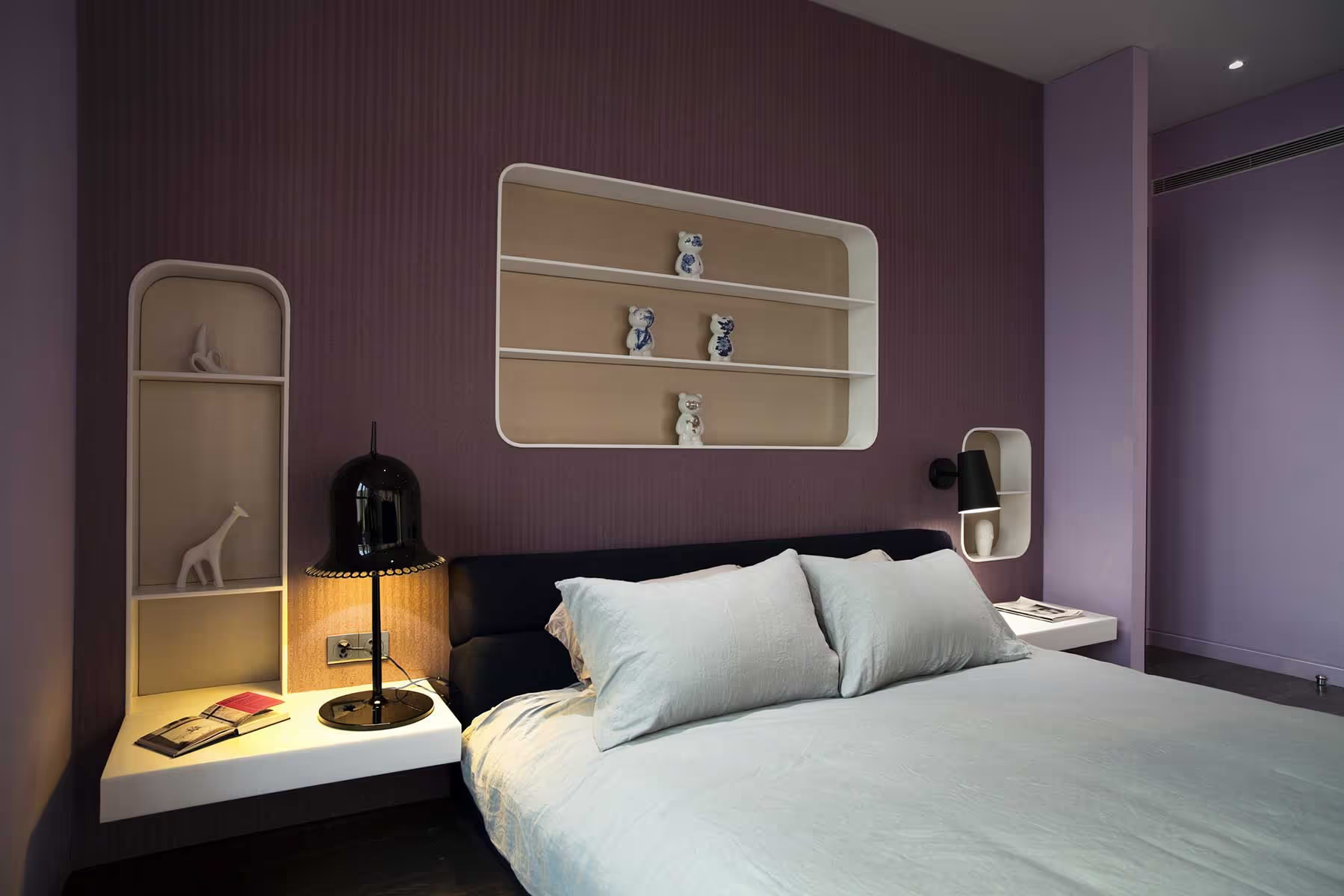
You have seen this coffee shop because it's everywhere from New York to Los Angeles to Seoul. The machine did not predict these spaces and the spaces did not copy the machine. Both are drawing from the same source, which is the feed, and the vertigo of the moment is that the built world and the generated image have become two outputs of a single process, indistinguishable in a photograph, and increasingly indistinguishable in person, whether the sign on the door says coffee or clothing or nothing at all.
The comfortable explanation is that this is what trends have always done. Fashion absorbed punk within a few seasons of its appearance on King's Road and sold it back through department stores with the pins pre-attached. Thomas Frank (The Conquest of Cool) showed that the advertising industry of the 1960s took real symbols from the counterculture, stripped out what made them dangerous, and sold the sanitized version back to everyone. Co-optation is at least sixty years old. If a look emerging and a look being everywhere were the same phenomenon, the sameness of the modern store design would be nothing new, an old machine running at its usual speed. But trends, in all those decades, never produced this. Punk took years to travel from one shop in London to the rest of the world, and it aged as it traveled, losing charge with every mile, so that by the time it reached the suburbs it was a costume. What is happening now has no such journey in it. Something in the machine changed, and the trend explanation cannot say what.
It helps to remember what the internet did first, because almost everyone has forgotten. Its first act was fragmentation. The world exploded into infinite pieces and ideas from remote places traveled to other unexpected places: a ceramicist in one country reaching a reader in another who would never have encountered that work through any magazine, any distributor, any physical channel that existed before. For a moment the geography of culture genuinely dissolved, and dissolution meant dispersal, variety multiplying in every direction at once. Very exciting times and I made an entire show about this at the Memphis Postdesign Gallery in Milan in 2002.
Then the same system began showing everyone the same fragments. And then it grouped the fragments into categories and fed each category back to the people it had sorted into that group, so that every cohort now lives inside a loop of its own reflections. The explosion ran in reverse. We arrived back where we had started, at uniformity, with one difference: the uniformity is now planetary. The world is flat. The phrase was once a promise, flatness as openness, capital and ideas moving without friction toward opportunity. The same word now describes where all that motion ended, a surface with no relief left on it, flat the way a landscape is flat after erosion has finished with it.
Two things distinguish this flatness from every previous cycle of absorption, and neither of them is the algorithm's cleverness. The first is time. There used to be a lag between a thing existing and a thing being sold, and inside that lag the thing could mean something. Punk had years. Grunge had perhaps three. The lag is now gone entirely; a look is a template before it has finished being a look. The second is shape. Punk had a street address. Grunge had a city. There was an original, a degree zero, and everything else was the copy, aging and morphing outward in rings. The store of this decade has no origin at all. It did not start in Tokyo or Brooklyn and radiate. It appeared in all of them simultaneously, because no one was copying a place. Everyone was copying the same feed at the same moment. This is not faster diffusion because it's the end of diffusion. It's a culture with no center from which anything spreads, only an everywhere into which everything arrives at once.
The proof that the loop is complete is what happened to the rebellion against it. A reaction did form, spaces built deliberately cluttered (hence the name Cluttercore), deliberately strange, hostile to the camera on purpose, rooms that refused to photograph well as a matter of principle. Within roughly two years, the refusal had a name, a place in the trend forecasts, and a checklist of its own: imperfect furniture specified to look imperfect, fluted plaster in the approved rhythm, the restroom redesigned as a photogenic surprise. The uniform produced a counter-uniform and the system absorbed both at the same speed, because the system does not care which cohort a room belongs to, only that it belongs to one.
And now the loop has shed its last dependency, which was reality. Until recently, the feed needed a photograph, and a photograph needed a room, an actual place where a camera or phone had been. The newest image generators accept a board of collected pictures and return more of the same aesthetic, images of rooms that have never existed, averages of thousands of previous averages. Those images go onto real mood boards, get approved by real clients, get built by real contractors, get photographed on opening day, and re-enter the feed carrying no mark of their origin, because they have none. This resolves the question the opening of this essay planted. Where did the machine's coffee shop come from? Nowhere. It has no author, no address, no first instance. Store design does itself now, and builds itself through us, and the only ingredient it cannot supply is the one thing an average is mathematically incapable of containing, which is a decision that no one else has made.
Marc Augé gave a name to airports and hotel corridors, the non-places, spaces of pure transit where no one is from and nothing accumulates. He thought he was describing the margins of life, the connective tissue between real places. He was describing the destination instead. The cafe on the corner, the store on the main street, the rooms built specifically to be somewhere, are now designed to feel like the space between somewheres, and a person can cross the entire planet without ever leaving that room. What it costs to make a room that is actually a place, and why almost nothing built this year will be one, is a question the room itself cannot answer. It was never asked.