.svg)

A few years ago, we wrote an article titled “Why most retail stores are destined to fail”, in which we described a fundamental switch in the way products are sold and brands build relationships with customers. Eight years later, the landscape is much different and the horizon even more clear, but the claim we made back then remains intact.
Today, retail interiors must justify their existence. With most products available online, physical stores succeed only by offering values you cannot get on a screen. Interior design is the main way to express this value.
Unique shopping experiences result from carefully designed conditions that guide attention, behavior, and memory. The following ideas show how retail interiors can promote engagement using spatial intelligence rather than decoration.
Experience before layout
The first design decision should focus on the intended experience, not the floor plan or the retail layout. Before drawing walls or placing fixtures, the designer defines a progression of tasks: arrival, orientation, exploration, comparison, decision, pause. Retail interiors that feel intuitive are almost always the result of this reverse process. The layout is the consequence of this analysis, not the starting point. An engaging retail environment selectively slows visitors. Narrow passages, lighting changes, and material shifts signal attention points. Open areas stimulate wandering, while quiet ones foster intimacy.
Design tip: Sketch the customer journey as a timeline rather than a floor plan; mark feelings instead of functions or sequences of products; translate these states into spatial conditions afterward. Overload shortens attention spans and reduces perceived value. Unique shopping experiences rely on restraint.
Interior design can support curiosity through absence. Limited product displays, controlled sightlines, and intentional empty space encourage movement and discovery. Guiding customers, rather than confronting them, increases engagement.
This approach also helps build brand clarity. A curated store communicates confidence and signals that every element is intentional. When the size of the store allows for it, the focus should be on “chapters” rather than zones. Each area has a slightly different atmosphere while remaining part of the same narrative. Customers read the space progressively, never all at once.
Material as brand language
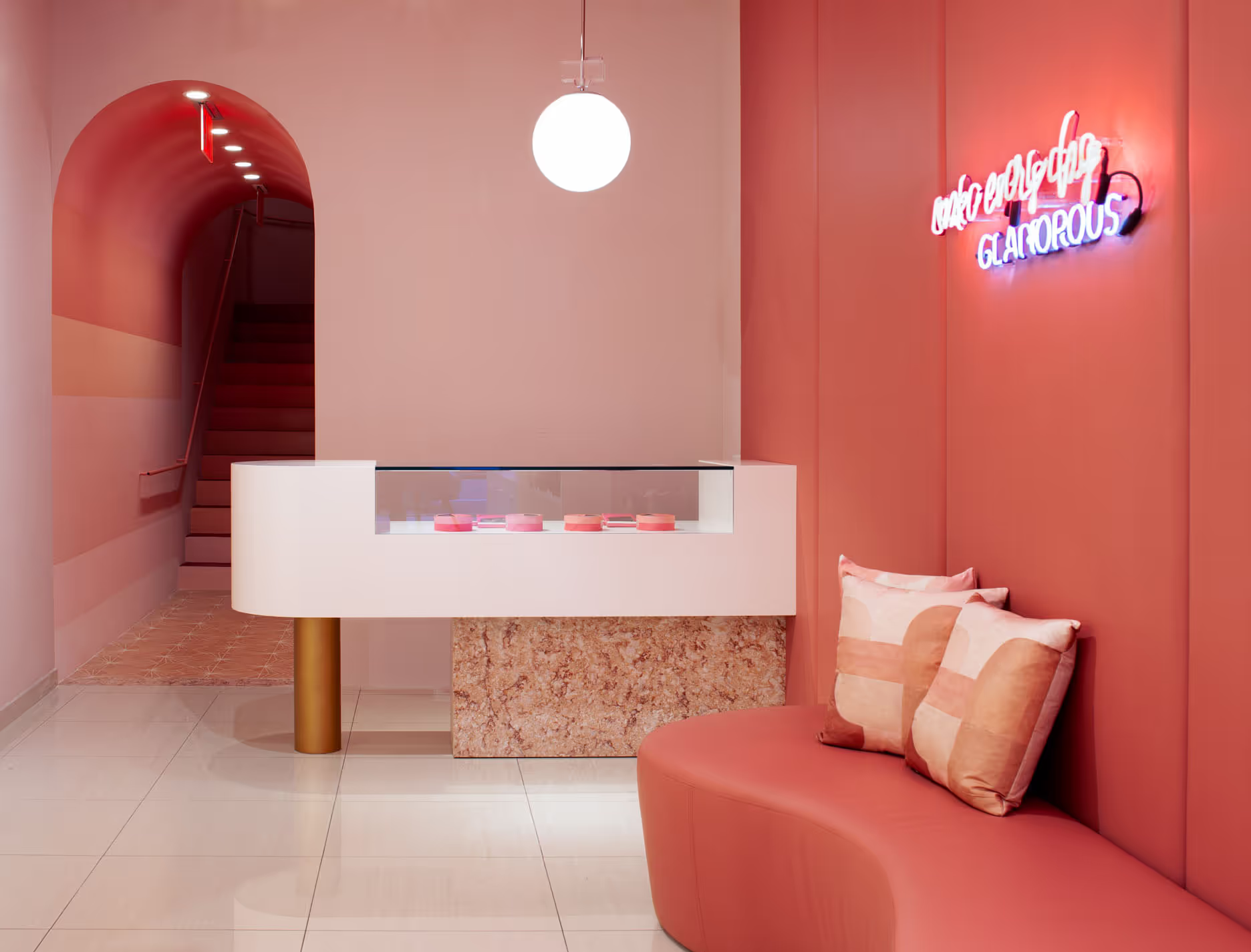
Materials do more than we imagine at a subliminal level: they immediately communicate values. Texture, weight, reflectivity, cultural histories, and how materials age all influence perception. Marble can be seen as a luxury item in one environment and as tacky in another, with these perceptions largely shaped by its surroundings. It’s like cooking: you put too much sugar, and the cake is unpleasant, too much sauce on a pasta dish and the experience is cheap. Engaging retail environments use a focused material palette based on the meaning that each material and shade brings with it. Customers read messages through colors and finishes; you are actively communicating with them at all times. Repetition builds recognition, while variation in scale or application prevents monotony. The result must be coherent and composed. This is especially important for brands that position themselves around quality, care, or precision. Materials should feel honest. When surfaces age well, the brand gains credibility over time.
Design tip: Select materials for how they change, not just how they look on opening day. Patina is part of the experience. Japanese culture knows it well, and Wabi-Sabi is becoming a known concept even in the Western hemisphere.
Technology as a spatial support system
Technology alone does not create experience. When it dominates visually, it competes with products and distracts customers. Effective retail interiors treat technology as infrastructure, rather than a feature. Most luxury brands are removing video screens from their stores entirely. Use them with care and design the videos, not the screens. It’s the content that matters, not the presence of a screen that nobody wants to watch. We watch videos all day long on our devices, the last thing we want is to watch them in real life too, unless the message is strong.
Digital tools are most effective when they remove friction, such as by simplifying information access, supporting customization, or easing transitions from browsing to purchase. When technology stays in the background, the space feels more human. The best technology is the one you don't see.
Retail interior idea: Create “silent tech zones”, areas with digital features that activate only in response to customer behavior. The default environment remains calm and physical.
Engagement through participation
People remember experiences they participate in. Retail interiors that encourage participation create more meaningful relationships than those leaning entirely on display. Participation does not require performance. Touching materials, configuring products, rearranging elements, or influencing the environment are all subtle ways to involve customers. Design can encourage this by reducing barriers between customer and object. Flexible fixtures, modular displays, and adaptable lighting let spaces change throughout the day or week. Repeat visits feel fresh while building memories.
Design tip: For brands with multiple stores, uniqueness means applying consistent spatial logic in different ways, not creating repetition.
Cohesion comes from shared principles, such as entry sequence, product presentation, material combinations, and lighting. Clear rules let each location adapt to its surroundings while maintaining brand identity. This strategy avoids replication and keeps interiors current. The brand evolves spatially while staying recognizable.
Measuring engagement without reducing design to metrics
Not everything important can be measured, but observation is essential. Time spent in areas, movement patterns, and hesitation points reveals how the space performs. Feedback is equally valuable. What people remember, where they pause, and what they photograph indicate whether the experience resonates. Design improves when spaces are viewed as prototypes, not finished statements.
Retail interiors as cultural devices
Unique shopping experiences result from clear intent and perfect design, not from pursuing novelty. Successful retail interiors function as cultural devices. They frame products within a system of meaning, pace, and attention, respecting visitors’ time and intelligence. When interior design reaches this level, the store no longer competes with online retail but offers something fundamentally different: presence, focus, and memory.